
Gap fills occur when a stock opens at a different price than the previous day’s close, leaving a price gap that often gets filled within the same trading session. This guide covers what causes gaps, how to identify which ones are worth trading, two entry strategies, and how to mark up your charts so you’re ready before the open.
LD By Lane Dotson · Last updated
Gap fills in stock trading is when a stock opens at a higher price than the previous day closed at or when a stock opens at a lower price than the previous day closed at. So for example, if Tesla closes the previous day at $404 and then opens the next day at $415, there is a gap in price that happened overnight.
It is important to note that smaller gaps can also appear in price during the trading day dues to various reasons such as extremely bullish or extremely bearish sentiment from traders expecting a big move or even a trader with large sums of money placing market order trades when there are no other limit orders nearby for them to buy or sell into. But for this article, we are going to focus on the more tradeable and probable gap fills that happen overnight or between trading sessions.
The most popular way to trade gap fills is to wait for the price of the stock to return to the previous day’s close price and then trade the reversal off of that level. This happens quite often and is a viable trading strategy if you can be patient enough to wait for the gap to fill and some days not be able to place trades if your watchlist of stocks does not have any gaps to fill.
Once the gap has been filled, it is important to wait for a pivot to be made so you don’t enter and then the stock keeps going in the same direction. So wait for the pivot to be made and then place your entry, with a stop loss below that pivot point. Then look for the stock to return to the open price for the day or the day’s high or low and use those as your target levels to take profit at. Make sure to trail your stop loss along the way as the stock moves in favor of your trade so you don’t let a winning trade turn into a losing trade.
Many times stocks will range in a sideways market until the news is announced and won’t give any gap fill opportunities, but outside of that, you can typically find a decent amount of stocks with gaps to fill if you watch enough stocks. Just make sure to stick to large cap stocks so there is plenty of liquidity for you to be able to efficiently enter and exit your position without much slippage.

When a stock gaps up or down and then continues that direction, if it is a very strong trend, it may not fill the gap at all. In this situation, you need to look for the stock to move in the same direction as the gap just after the market opens and then wait for the stock to come back to the day’s opening price and form a pivot there. Once that pivot forms, you can place your entry in the same direction that the market was trending and then ride that move until it starts to form a reversal pivot. Place your stop loss just beyond the pivot that was made at the day’s opening price and then make sure to trail your stop loss as price moves in your favor.
Sometimes when the trading gap fills, the gap will get completely filled and then continue on. This is typically when the gap up or gap down was met with a lot of resistance and doesn’t have enough traders that believe in the continuation, so the stock fills the gap and then continues in the opposite direction of the gap. When this happens, you need to make sure you get out of your position and wait until the next day or look for other stocks that actually form a pivot once the gap is filled. This is why we mentioned earlier that you should always wait for a pivot to be formed before taking your trade, otherwise you are entering your position on what is called a falling knife which can be very dangerous.
As we mentioned in the strategy about breakaway gaps earlier, look for a pivot and volume spike when the stock returns to the open price and trade that instead. If price does not return to the open price and just rockets out of there, do not trade that as it is likely that the market will swing wildly and stop you out. Remember, preserving your capital is just as important as winning trades, so always use proper risk management when trading and stick to your plan, even if your ideal setup doesn’t appear that day. Patience is key in trading and it will be your most important step to consistently profitable trading, so don’t overlook it.
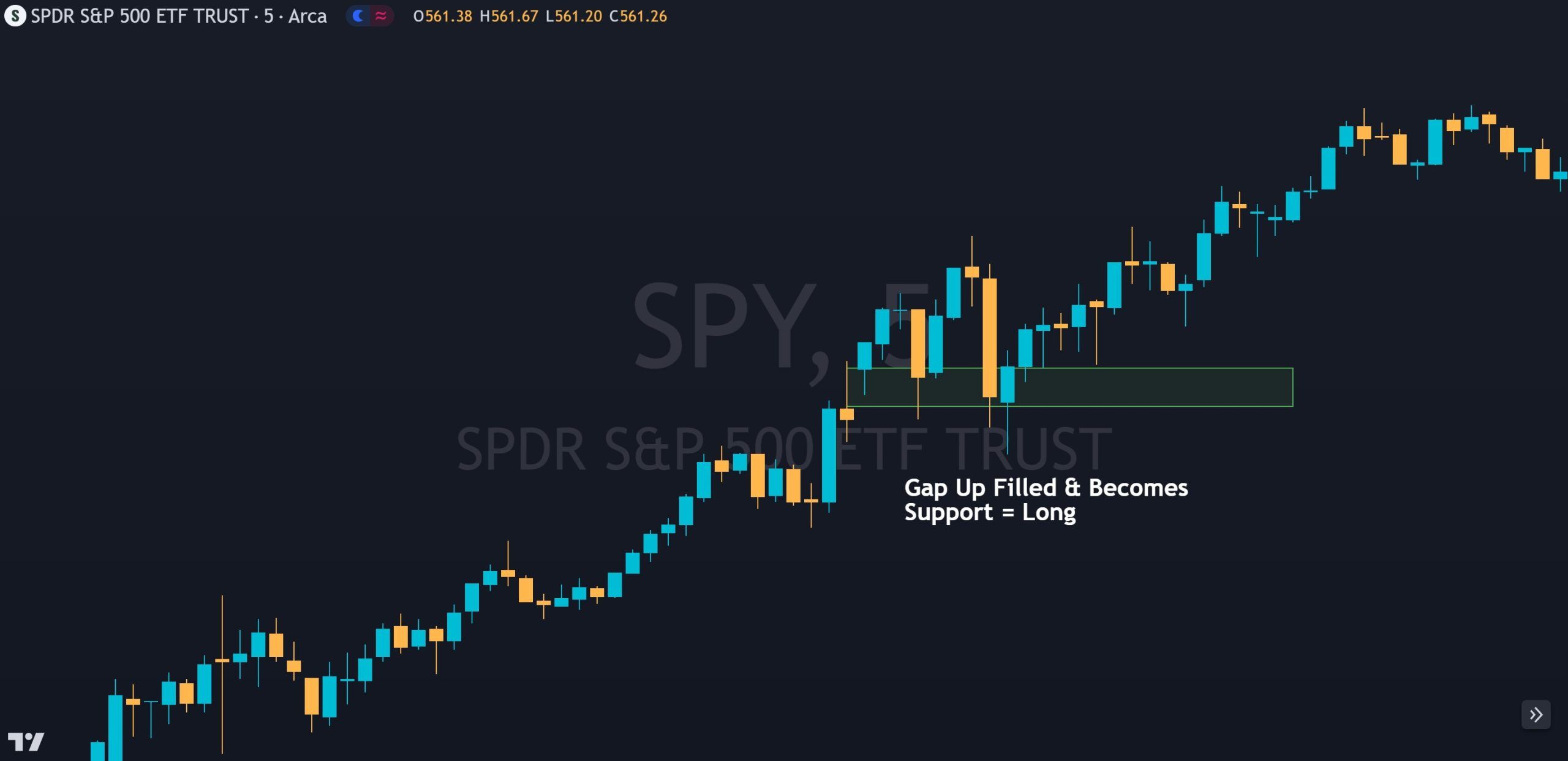
When the market opens higher than the previous day’s close price, this is a gap up and we will be looking for long trades to enter from within the gap. Draw a box from the previous day’s close price, up to the current day’s opening price and then extend that box to the right for the rest of the trading day. If the market gaps up like this, color your box green to show you that the market will likely bounce back up after filling the gap.
When the market opens below the previous day’s closing price, this is a gap down and we will be looking for short trades from within the gap. Draw a box from the previous day’s close price to the current day’s opening price and extend the box to the end of today’s trading hours. Color the box red to signify that you are looking for a short from the gap.
Most gaps do get filled eventually, but not all of them and not always on the same day. Common gaps and exhaustion gaps tend to fill relatively quickly, often within the same session or the next few days. Breakaway gaps that form on strong volume during a trend may take weeks, months, or never fill at all. The key is to trade the setup when conditions are right rather than assuming every gap must fill.
A gap fill trade targets a stock that has gapped up or down and is expected to return to the previous day's close price during the session. A breakaway gap is when a stock gaps strongly in one direction on high volume and continues moving that way instead of retracing. Breakaway gaps often don't fully fill — instead, you trade the continuation after price pulls back to the day's open price and forms a pivot, not back to the prior close.
Focus on large-cap, liquid stocks with clean gaps between the previous close and the current open using regular market hours data only — exclude premarket. Avoid stocks with major negative news like bankruptcy filings or catastrophic earnings misses, since those gaps may not fill. The best gap fill setups occur on stocks in strong trends that have a moderate gap with no obvious reason for the price to continue in the gap direction.
Get out and wait for the next opportunity. If price fills the gap and continues moving through it without forming a reversal pivot, your trade thesis is wrong for that session. This is why waiting for a pivot to form before entering is critical — you should never be entering into a falling knife or a runaway move. A confirmed pivot with a stop just beyond it keeps your risk defined and keeps you out of the trap of hoping a gap eventually reverses.
BETTER TOOLS, BETTER TRADES
Explore our day trading indicators built specifically for intraday trades.